
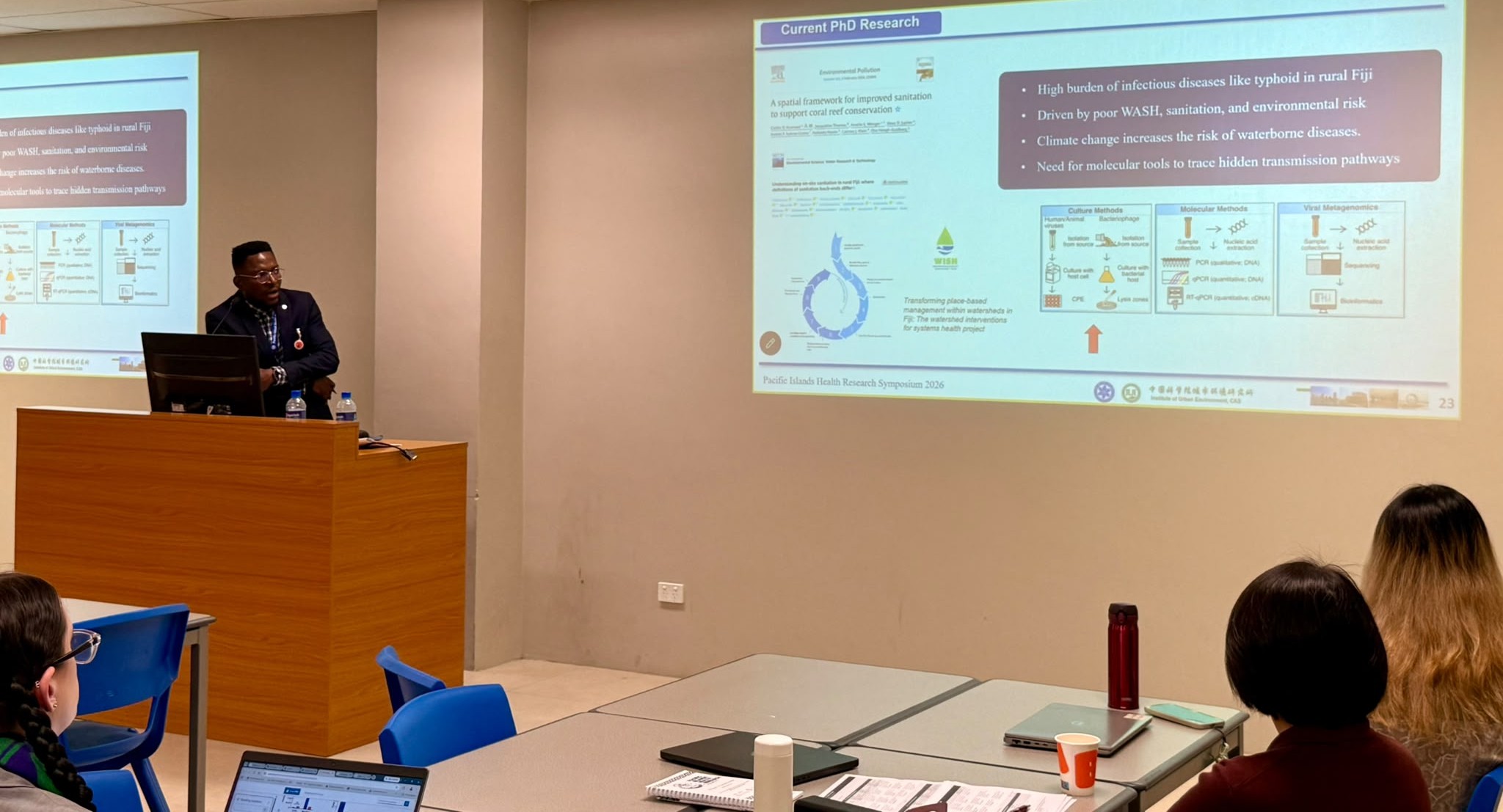
New research into how viruses are transported within the human gut could provide valuable insights into disease transmission and environmental health across Pacific Island Countries (PICs).
Alex Obeten, originally from Nigeria and currently a Doctor of Philosophy (PhD) student at the University of Sydney in Australia, presented his research at the Pacific Islands Health Research Symposium held at the Fiji National University (FNU) Nasinu Campus from 31 August to 4 September.
His presentation, titled “Decoding Extracellular Vesicle-Mediated Encapsulation of Enveloped and Non-Enveloped Gut Viruses through Phosphatidylserine Affinity Profiling”, explored how viruses can be transported inside tiny biological structures known as extracellular vesicles (EVs).
Obeten works closely with the Watershed Interventions for Systems Health (WISH) Pacific Project, which focuses on understanding environmental and health risks affecting communities.
“In my research, we are using molecular ecology to link Fijian watersheds with environmental risk factors,” Obeten said. He said the research was particularly important for rural communities, where waterborne and faecal-borne diseases remain a concern.
“There is evidence of significant transmission of waterborne and faecalborne diseases in rural communities. Through WISH Pacific, we are looking at these issues from a systems-health perspective, particularly how sanitation influences disease transmission,” he said.
Viruses are traditionally classified as either enveloped or non-enveloped, depending on whether they possess a lipid membrane. However, emerging evidence suggests that even non-enveloped viruses can be enclosed within extracellular vesicles, potentially changing how they survive, spread and evade the immune system.
Obeten’s study aimed to identify and characterise viruses encapsulated within EVs in the human gut and investigate their prevalence, diversity and potential functions.
“Our research team has used specialised laboratory techniques to isolate phosphatidylserine-positive particles from human stool-derived viral-like particles. Wethen used advanced imaging and metagenomic sequencing to identify and analyse the viruses.”
“The findings showed significant enrichment of enveloped viruses, while free non-enveloped viruses were reduced.
However, the EV-associated viral populations were dominated by nonenveloped viruses, with strong associations identified with bacterial families including Enterobacteriaceae and Bacteroidaceae,” he explained.
He also mentioned the research could also contribute to future disease surveillance and therapeutic strategies, particularly as communicable diseases continue to pose challenges in the Pacific.
“Our findings challenge the traditional understanding of how viruses are classified and transmitted.” “The way viruses interact with extracellular vesicles may have important implications for viral evolution, transmission and their impact on human health,” he stated.
Obeten added that the research was also being supported by laboratory capacity at FNU.
“We already have a laboratory established at FNU with qPCR equipment, and we are now moving towards sequencing samples collected from communities,” he added.
He said combining environmental sampling, molecular research and community-based data could strengthen understanding of health risks and support evidence-based solutions for Pacific communities.
Source: Romeka Kumari, 2026 September INSIDE FNU