
In the high islands of Melanesia, life and disease follows the water. Most communities are settled within watershed areas, making these ecological zones the frontline for environmental spillover and infectious disease outbreaks.
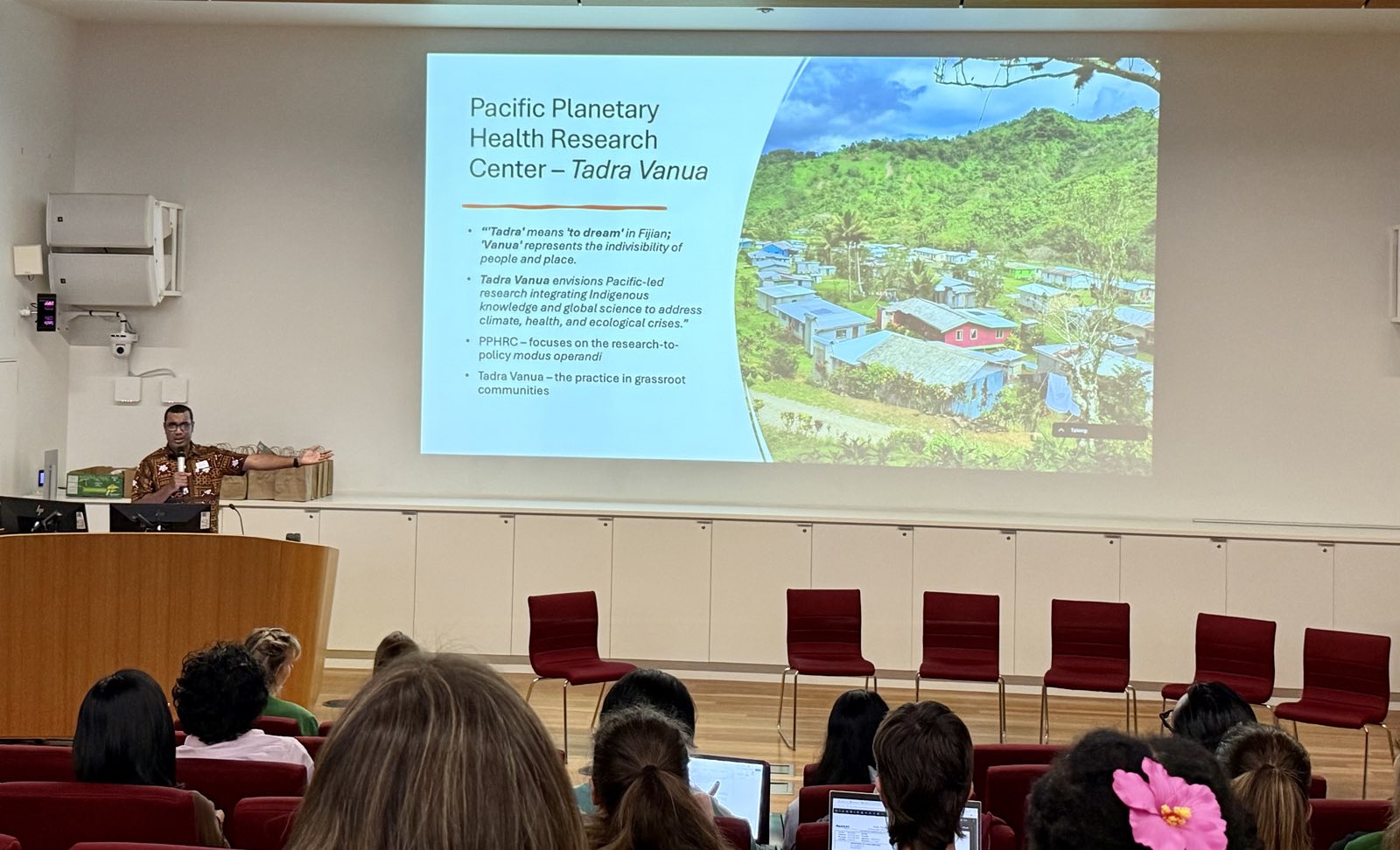
Speaking at the SPARKLE One Health Symposium in Melbourne on November 4, 2026, Timoci Naivalulevu, WISH Pacific Project Manager at the Fiji Institute of Pacific Health Research (FIPHR), outlined how Pacific researchers and communities are rethinking public health not as a top-down clinical intervention, but as a deeply rooted, place-based partnership.
Traditional health systems often place humans at the center and treat governance as just one of several operational pillars alongside finance, service delivery, information, human resources, and medical technology. Naivalulevu and his team flipped that model.
In the WISH (Watersheds for Systems Health) project, governance is treated as the central motor driving the entire system, surrounded by the interconnected realities of water, ecosystems, land, climate, and disease vectors. To make this work, researchers and managers have had to become “T-shaped” combining deep technical expertise with the broad collaborative reach needed to bridge vertical gaps between government and grassroots communities, as well as horizontal silos across ministries that rarely interact.
Drawing on Pacific identity and the imagery of Maui’s fishhook, Naivalulevu described a project framework designed to hook sustainable interventions only after laying deep relational groundwork. Central to this is a rigorous, three-phase Free, Prior, and Informed Consent (FPIC) process that goes well beyond standard institutional ethics approvals:
- Traditional Consultation: Engaging local government and sitting directly with village leaders to discuss the project’s purpose and seek permission to enter the community.
- Community Awareness: Hosting open gatherings where residents can ask questions, understand how the research affects them, and actively shape the project’s direction.
- Formal Representation: Securing signed collective agreement from community representatives before a single piece of data is collected.
“You have heard the term, ‘It takes a village to raise a child.’ It also takes a village to actually move things forward, particularly around One Health.”
The process took five months before implementation even began. However, Naivalulevu noted that the slow, deliberate pace proved decisive: communities brought on board in 2019 have remained committed partners through every phase of data collection, risk mapping, and water and sanitation safety planning.
Implementing One Health requires breaking out of professional isolation. Naivalulevu shared how his team actively brought together officials from the Ministries of Health, Agriculture, Forestry, Fisheries, and even the police – sometimes using the simple incentive of a funded lunch to get busy department heads in the same room.
In one instance, a Ministry of Health official and a Water Authority of Fiji laboratory technician realized during a district consultation that they had graduated from the same School of Public Health years earlier, yet had never collaborated professionally. Turning those dormant connections into active working networks is at the heart of the team’s strategy.
True partnership also meant adapting when crises hit outside the original research scope. Between 2019 and 2022, Fiji endured the COVID-19 pandemic alongside two severe tropical cyclones following the devastation of Category 5 Cyclone Winston, as well as water-quality threats in the eastern Lau group triggered by the volcanic eruption in Tonga.
Rather than retreating into rigid project boundaries, the WISH team pivoted to support their partners distributing WASH and hygiene kits for women and girls, supplying seeds to farmers, providing PPE to local officials, assisting Fiji CDC laboratories with testing and data entry, and training frontline health workers to conduct emergency water testing.
Naivalulevu also introduced the Pacific Planetary Health Research Centre (PPHRC), which he coordinates. Known locally as Tadra the Fijian word for “dream” the center houses major climate and health initiatives including WISH (funded by DFAT), RISE, and REFLECT (both funded by the Wellcome Trust).
The name Tadra reflects a dual vision: honoring elders’ memories of thriving ecosystems from the past while dreaming of a resilient future. Guiding this work is the concept of Vanua, the holistic Pacific worldview in which people, land, and place are inseparable, paired with Tanuku, the practical application of research directly within grassroots communities.
Closing his address on behalf of FIPHR’s director, Naivalulevu urged global researchers and policymakers to move past academic jargon and focus on real-world practice. Navigating climate and ecological health crises requires embracing complexity, respecting intergenerational equity, and testing solutions through place-based models before scaling them.
His message to international partners looking to engage in the region was clear: work with the Pacific, led by the Pacific.