
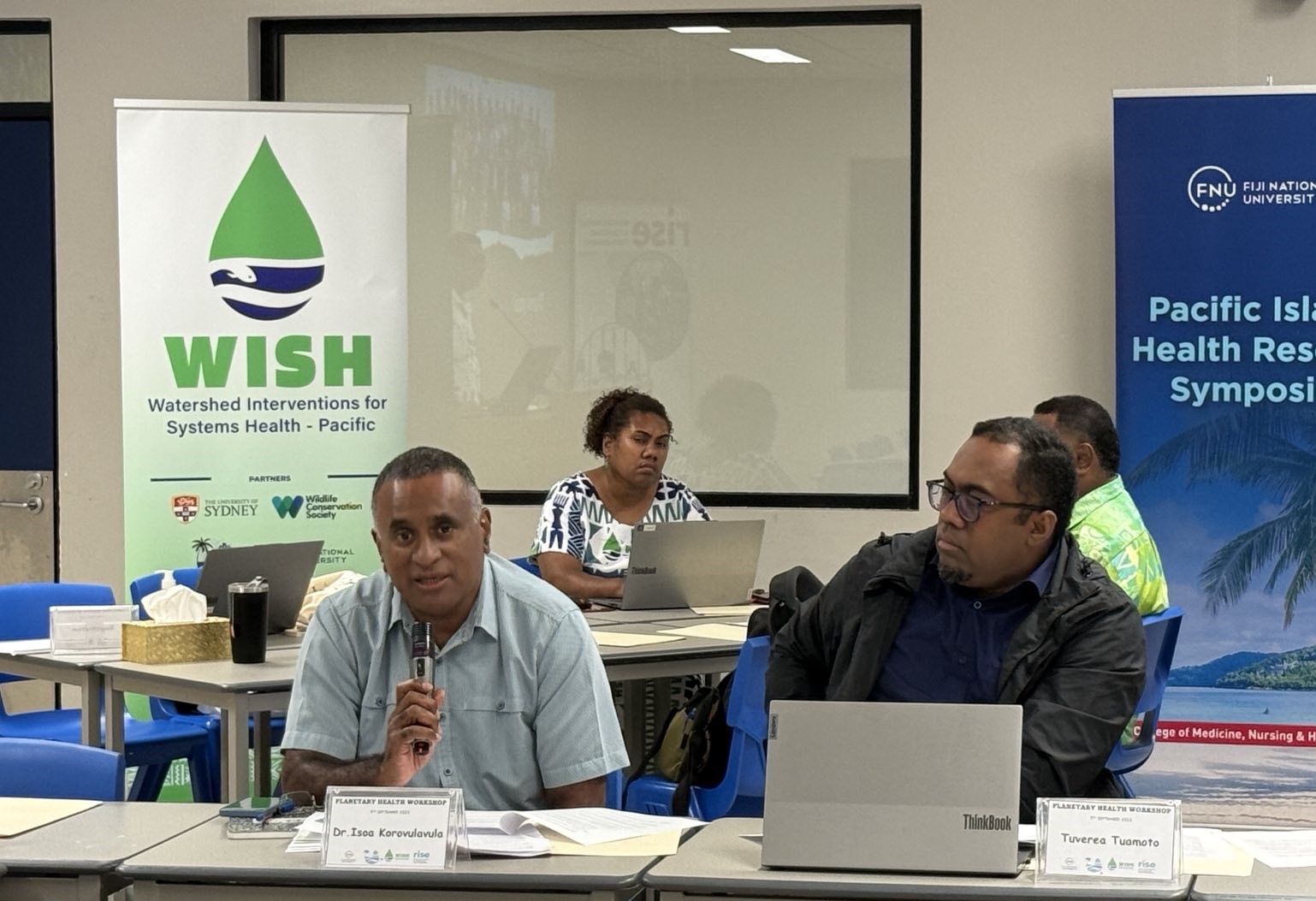
In a crucial step toward bolstering regional health security, a workshop focusing on One Health and Planetary Health approaches was recently held, preceding the 2025 Pacific Islands Health Research Symposium (PIHRS).
Hosted jointly by the WISH Pacific and RISE projects, the side event – titled The Ecological & Environmental Drivers of Health – Understanding One Health & Planetary Health Approaches – sought to deepen collaboration on issues where human, animal, and environmental health intersect.
This gathering served as a direct follow-up to the discussions held during the Fiji Workshop on Developing an Integrated Surveillance for Leptospirosis in July, which was facilitated by the Pacific Community–SPC.
The meeting brought together key representatives from a diverse range of sectors, including:
- WHO
- WAF (Water Authority of Fiji, likely)
- Ministry Of Health and Medical Services
- USP (Institute of Applied Sciences)
- Biosecurity Authority
- PNGIMR (Papua New Guinea Institute of Medical Research)
- CMNHS School Of Public Health
The primary aim was to forge stronger, integrated systems for managing health risks driven by environmental factors. The specific objectives included:
- Improving the understanding of environment and ecological drivers of disease.
- Fostering stronger multisectoral collaboration and systems thinking.
- Refining the content for a planned regional Planetary Health short-course.
- Facilitating regional knowledge exchange and alignment with the upcoming PIHRS.
This multi-sectoral collaboration, spanning health, agriculture, animal health, and the environment, is instrumental in establishing a robust One Health framework designed to enhance zoonotic disease surveillance.
The workshop specifically used zoonoses like leptospirosis as critical case studies. Participants explored how the Pacific’s significant vulnerability to Climate Change, biodiversity loss, and ecological degradation directly fuels disease emergence and spread through factors such as changes in land use, water quality, sanitation, and ecosystem disruption.
It’s clear that there’s no single solution, but through the collective efforts of all stakeholders, the meeting marked a significant stride toward creating a strong regional roadmap, ensuring that the critical links between climate, health, and the environment remain central to the Pacific’s research and policy agenda.